
Documentation, Reference Materials, and Tutorials for WPCode
Would you like to see exactly which snippets and scripts WPCode is putting on a page of your site?
In this guide, we’ll walk you through the WPCode menu in your WordPress admin bar. It lists everything WPCode loaded on the page you are viewing and links straight to the place each one is managed. All you need is a page on your site and a few seconds.
Before you get started, make sure WPCode is installed and activated on your WordPress site.
To get started, we’ll confirm the WPCode menu is switched on.
WPCode adds its own item to the WordPress admin bar. That item is where the list of loaded code lives. WPCode switches it on the moment you activate the plugin.
It is still worth knowing where the switch is, because it is also how you tuck the menu away again.
From your WordPress admin sidebar, go to Code Snippets » Settings.
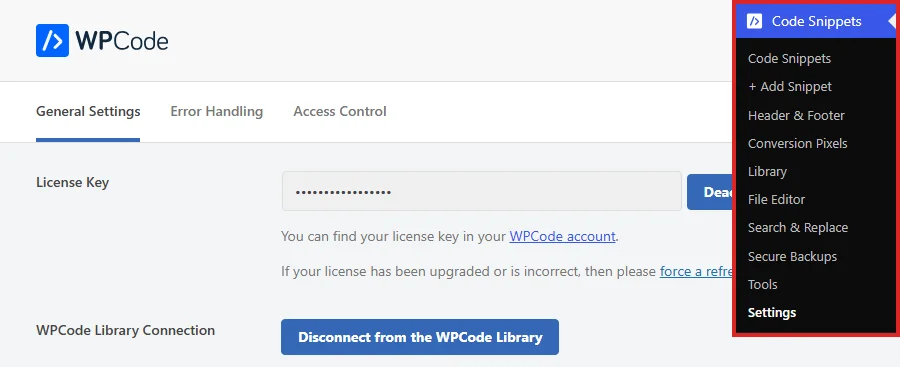
The General Settings tab opens first. On this panel, scroll down to the Admin Bar Info row. Its toggle is blue when the menu is switched on.

If you ever change this toggle, the panel keeps a save button at the very bottom. Once the toggle reads the way you want it, click Save Changes.
With the toggle on, the WPCode item is ready and waiting in your admin bar.
The menu gathers its list while a page is being built. That means you read it on the front end of your site rather than in the admin.
Next, open any page of your site in your browser while you are still signed in to WordPress.
Note: The admin bar appears on the front end for signed-in users who have Show Toolbar when viewing site ticked on their WordPress profile. WordPress ticks it by default.
In the admin bar across the top, look for the WPCode item.
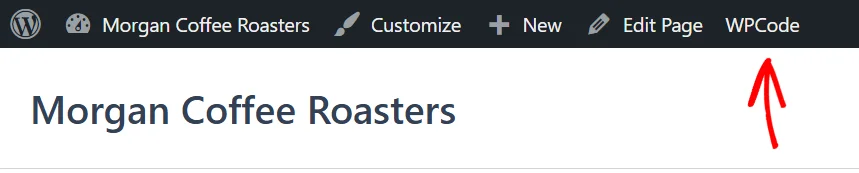
Hover over it and the menu opens. WPCode’s own documentation calls this the Code Spotter menu.
Under the heading Loaded on this page, the menu is laid out in three parts. Each part carries a count. At a glance, you can see where the code on this page came from.
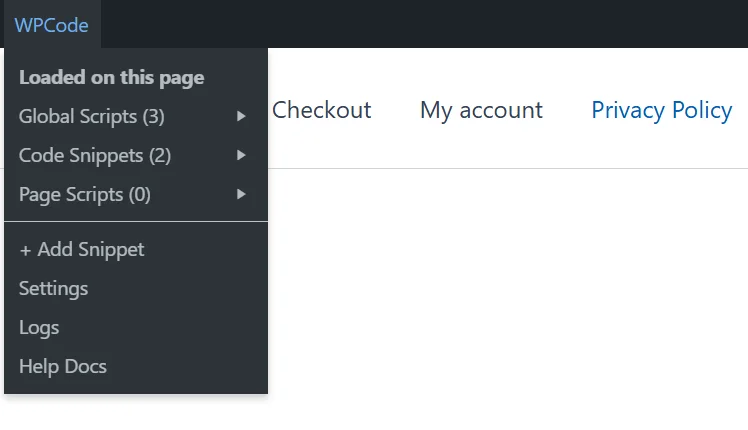
Below the divider sit a handful of shortcuts, which stay the same on every page.
Everything above the divider is a link. Every link lands on the screen where that piece of code is managed.
That is what makes the menu worth opening. You get from “something is loading here” to the exact field holding it in one or two clicks.
The first part of the menu covers the code you have pasted into WPCode’s global header, body, and footer areas. That code goes on every page of your site, which makes it the first place to look. Hover over Global Scripts to open it.
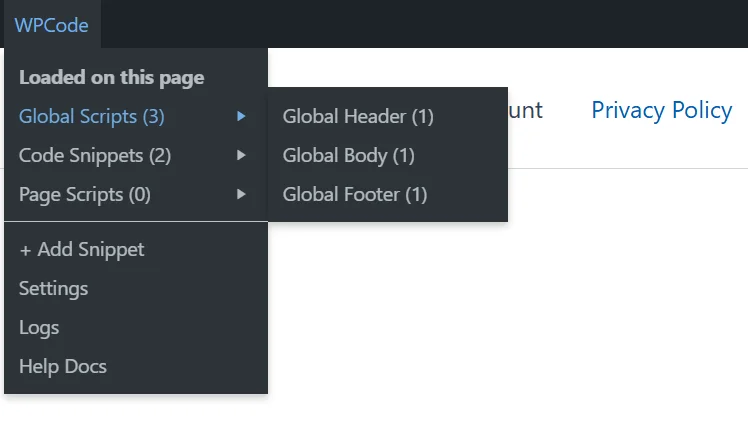
Each of the three areas is listed with its own number. That number is 1 when the area has code in it and 0 when the area is empty.
The count beside Global Scripts tells you how many of the three areas are in use. Selecting any of the three opens the Header & Footer screen at that area, ready to read.
The second part lists the snippets that actually produced something on this page. WPCode builds it while the page loads rather than from your snippet list, which leaves out any snippet held back by its conditional logic. Hover over Code Snippets to open it.
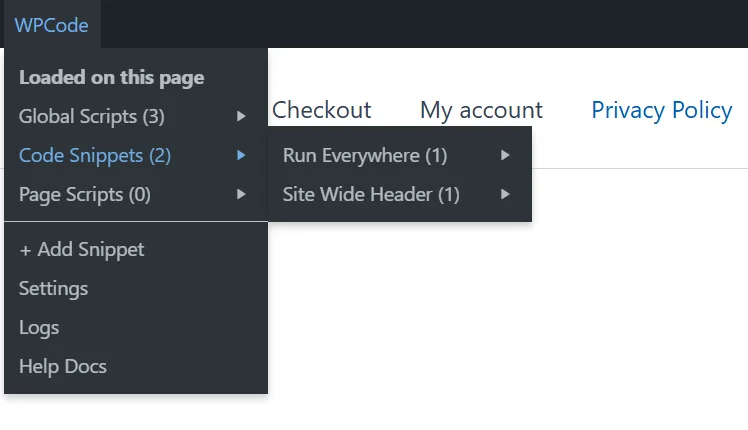
Snippets are grouped by the auto-insert location that put them on the page, with the number of snippets in each group beside the name. Grouping them this way answers a second question along with the first: not only which snippets ran, but where in the page they were inserted. Selecting a location name opens your snippet list filtered to that location.
The count beside Code Snippets is those group numbers added together. It tells you how many snippets ran on this page in total.
Next, hover over a location name to see the snippets themselves. Each one is named. Selecting a name opens that snippet in the code editor.
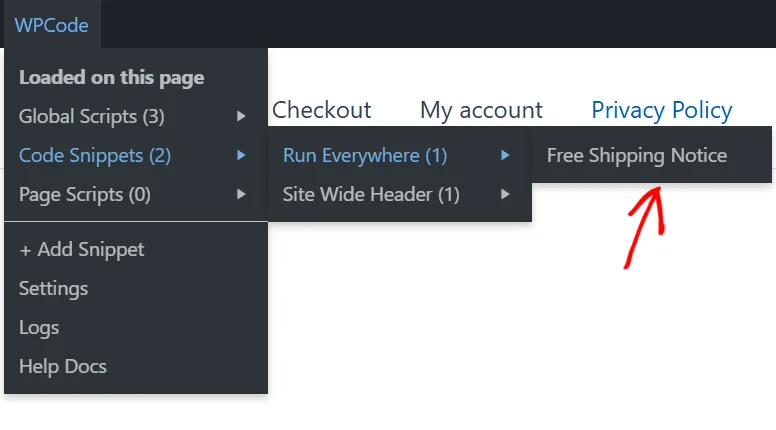
Conversion pixels appear in this list too, alongside your snippets and under whichever location they use. Selecting one of those opens its tab on the Conversion Pixels screen instead of the code editor. That is where a pixel is set up.
Note: The Page Scripts part of the menu comes with the paid version of WPCode.
The third part covers code attached to the single page you are viewing, rather than to the whole site. Hover over Page Scripts to open it.
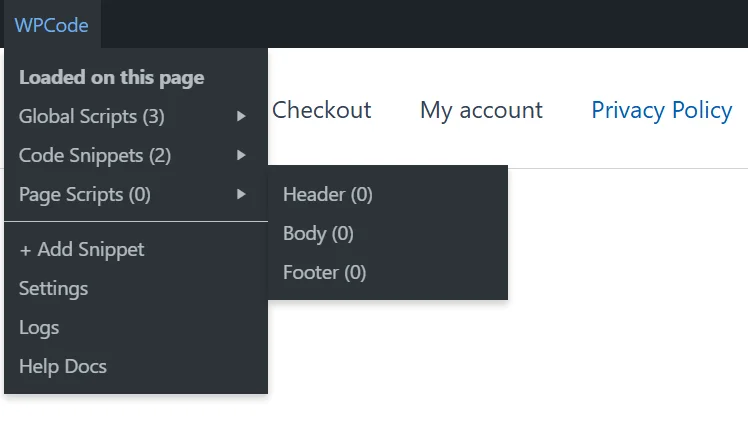
The same three areas are listed, counted the same way. Each shows 1 where that area of this page has code of its own, and 0 where it does not.
A page that has never been given its own scripts reads 0 across all three, which is a useful thing to confirm. Selecting one of them opens this page in the WordPress editor with WPCode’s own panel already open at that area.
If the page also has snippets attached to it directly, a Custom Code Snippets entry joins the three areas. Those snippets are grouped by location and named the same way as the site-wide snippets above.
That’s it! You can now open any page of your site and read back everything WPCode put on it. Next, our guide on snippet locations explains the location names the menu groups your snippets under.
Below, we’ve answered some of the most common questions about the WPCode menu in the admin bar.
Signed-in users who are allowed to activate snippets in WPCode. When you activate the plugin, WPCode gives that permission to every role that can already manage your site’s options. In a standard WordPress install, that means administrators. Your visitors never see the menu. Neither does anyone browsing your site signed out. See WPBeginner’s Beginner’s Guide to WordPress User Roles and Permissions for what each of the default roles can do.
No, and that is the point of it. Code Snippets is rebuilt from the snippets that produced output while that particular page loaded. Page Scripts reads the scripts belonging to the page you are on. Only Global Scripts reports the same three areas everywhere, because that code goes on every page.
They tell you whether the area is in use, not how many separate scripts you put in it. Each area shows 1 when it holds any code at all and 0 when it is empty. The count next to Global Scripts is those three numbers added together. That means it goes as high as 3.
Yes, and there it carries Code Snippets and the same shortcuts. Global Scripts and Page Scripts are front-end only. Your global code is not loaded on admin screens. Page Scripts describes a page a visitor is viewing. To see all three parts, open a page of your site.
The menu says so in place of the count. When a page switches off the global header, body, or footer for itself, that area is listed as Disabled via Page Scripts. That way you can tell an empty area apart from one that has been set aside for this page.
Straight into that snippet in the WPCode code editor, with the code and its settings in front of you. Conversion pixels are the one exception: they open on the Conversion Pixels screen, on the tab for the pixel you selected.
Future-proof your website with WPCode Snippets and improve the way you manage code across all your websites.
Copyright © 2026 WPCode. WPCode® is a registered trademark of WPCode, LLC


The WordPress® trademark is the intellectual property of the WordPress Foundation. Uses of the WordPress®, names in this website are for identification purposes only and do not imply an endorsement by WordPress Foundation. WPCode is not endorsed or owned by, or affiliated with, the WordPress Foundation.